This page is rapidly being superceded because I found my notes! I’ll eventually delete this and move the photos elsewhere


This page is rapidly being superceded because I found my notes! I’ll eventually delete this and move the photos elsewhere
5,6 November. 2024 Agua Calientes and Machu Picchu
We would see Machu Picchu twice: once this afternoon, when we explored the upper section, and again tomorrow, when we would visit the main area. Incidentally, it’s pronounced “Machu Peak-chu”
I have mentioned elsewhere in this website that my parents and I lived in Rome when I was a young teenager. One of the first things we did after moving there was visit the Colosseum, and I still remember that first encounter vividly.
We took the metropolitana (subway) downtown to the Colosseo station. We expected to have to walk a block or two, but when we came up out of the subway, there it was, right in front of us. Something we had seen so many times in pictures was suddenly across the street, in all its glory. It literally took our breath away.
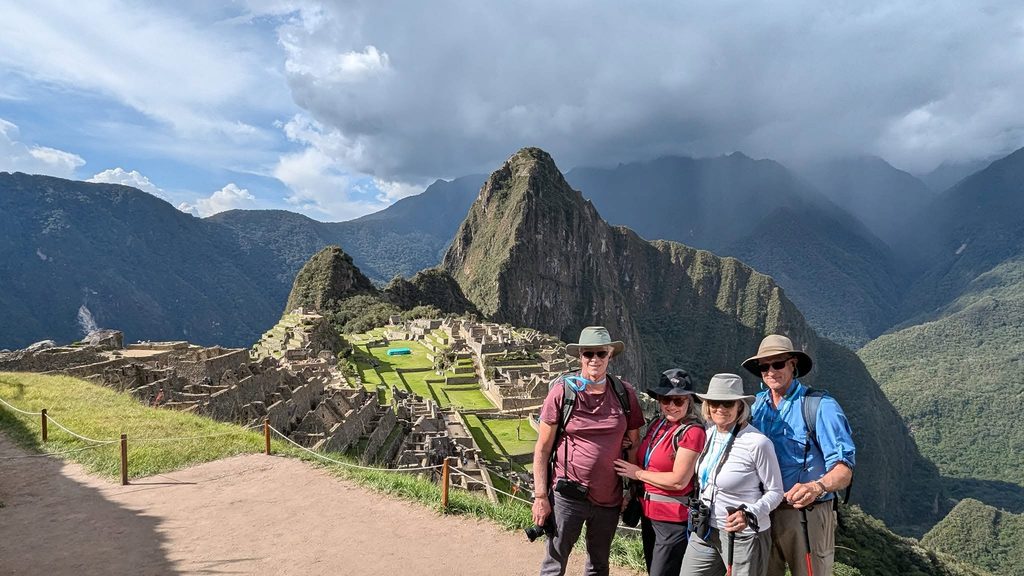
I had much the same feeling arriving at Machu Picchu. Getting there is an adventure in itself. After a long bus ride up the mountainside, negotiating 14 switchbacks , you finally reach the entrance. From there, you continue on foot, climbing to the upper viewpoint. And then you turn around. There it is. Machu Picchu, spread out before you, just as you have seen it in countless photographs, except now it’s real and you’re standing there looking at it. Like the Colosseo, it literally took my breath away.
3 November
We caught an early morning flight from Lima to Cusco and, rather than staying in the city, immediately boarded a bus for the Sacred Valley and the town of Urubamba.
I thought this was a very sensible way to begin our time in the Andes. Cusco sits at approximately 3,400 metres (11,150 feet), while Urubamba is around 2,870 metres (9,415 feet). That gave us a roughly 530-metre reduction in altitude and, hopefully, a gentler introduction to the thin air before coming back to tackle Cusco and Sacsayhuamán.
Still I had a slight headache for the first day.
4 November 2024 – Urubamba
Here’s an interesting statistic: 94% of the population in this area own their homes. They see home ownership as a form of savings. People start with a small house and, as they earn more, gradually expand it. We saw the same pattern in Lima. In this area, most people are farmers who also own the land they work.
OAT is also known for its “Day in the Life” experiences, where we get to participate in some of the everyday activities of local people. Today, we went shopping at the local market to buy ingredients for lunch. The menu was pico de gallo (a fresh salsa), chicha morada and guinea pig. Fortunately, the guinea pig had already been purchased and cooked, so we were spared that part of the experience!
Lunch was hosted by Emma and Big Momma, and we helped out in the kitchen. The chicha morada was particularly good – a refreshing drink made from purple corn, cinnamon, sugar and lime. As for the guinea pig, well, it tasted like chicken, of course. It had a crispy coating not unlike KFC and was actually pretty good. The only real challenge was trying not to think too much about what we were eating!
That evening, we had dinner at a local pollería (a restaurant specializing in roast chicken). The chicken was delicious, and after dinner the owner was quite happy to show us his collection of Inca and pre-Inca treasures, along with two original works by Victor Delfín. Delfin is the Peruvian artist who created the famous sculpture of a man and woman kissing in Lima. Quite an unexpected bonus after dinner! I did wonder, though, how he had acquired such a collection and whether Peru should have more control over its antiquities.
After dinner, we had OAT’s “Controversial Topic” session. A local farmer came to talk to us about coca, which she grows on her own eight-acre farm. Her children have grown up and moved to the city, leaving her to manage the farm herself.
She explained that there are several markets for coca leaves. She can sell legally to a government-authorized buyer, which supplies the legitimate market, including the pharmaceutical industry. There is also a widespread local market, where people chew the leaves to help with strength and endurance. This trade is technically illegal, although, according to her, the local police tend to turn a blind eye.
Then there is the illegal international market, where coca leaves ultimately find their way into cocaine production. That, of course, is quite another matter and one that is strongly frowned upon.
It was a fascinating discussion. We tend to associate coca exclusively with cocaine, but for many rural Peruvians it is an important traditional crop and a source of income. The distinction between its legal, traditional and illegal uses is not nearly as straightforward as we might have imagined.
5 November
The morning began with a Shaman’s blessing to Pachamama (Mother Earth), asking for good health and safe travels. From there, we headed to a small microbrewery making traditional corn beer. We had two flavours to sample: regular and strawberry. Both were worth trying, although I preferred the strawberry.
But the brewery had an added attraction. On the floor in front of us was what could only be described as a miniature condo for guinea pigs. You could select your future meal and then settle in with a beer while it took the next two hours to cook. Talk about fresh!
Unfortunately, we didn’t have time to take advantage of the offer. We had a train to catch in Ollantaytambo, bound for Aguas Calientes, the gateway to Machu Picchu. The guinea pigs would live to see another day!
Pictures to come!
1 November, 2024 Lima Peru
We had our tour briefing with our trip leader, Maricela, followed by a walking tour of the city. Along the way, she introduced us to a couple of local treats. First were picarones, a sort of Peruvian doughnut made with sweet potato and squash, deep-fried and served with a sweet syrup. Very good!
I also tried Inca Kola, Peru’s hugely popular soft drink. It actually outsells Coca-Cola in Peru, which eventually prompted Coke to buy a 50% stake in the business in 1999. It has a distinctive bright yellow colour and tastes a little like cream soda. Not quite what I expected, but I can see why Peruvians like it.
Maricela then took us by taxi to Barranco, one of Lima’s coastal districts, known for its bohemian atmosphere, galleries and street art. The murals were beautiful, and it was a very different side of Lima from the historic centre and Miraflores.
For dinner, I’d reserved a table for the four of us at Rafael’s, a restaurant recommended by an engineer who I knew who had done considerable work in Peru. It turned out to be a very popular restaurant, although you wouldn’t know it from the outside. There were no signs or other indications that a restaurant was there. All I had was an address, so I ended up asking a fellow on the street if he knew where it was. As it turned out, he was the doorman! After confirming we had a reservation, he let us in the nondescript front door.
Lima has a reputation for excellent food, and Rafael’s certainly lived up to it. We enjoyed scallops, squid and grouper, followed by chocolate cake. A very good evening!
We were also there over a holiday weekend. November 1 is All Saints’ Day and November 2 is All Souls’ Day, both important dates in Peru’s Catholic calendar.
2 November – Lima: Fish Market and Museo Larco
Today we visited the fish market. This wasn’t a tourist market; it was where many of Lima’s restaurants source their seafood. One of the special features of our OAT tour is the opportunity to meet and talk with local people rather than simply observe them. With Maricela translating, we spoke with several people, from vendors selling their catch at the market stalls to fishermen repairing their nets. It was a fascinating glimpse into an everyday part of Lima’s working life. Apparently, the ocean around Lima is teeming with fish due to the Humboldt current. This current brings cold water and nutrients up from the south. Despite much of Peru being in a desert region, Lima sits beside one of the world’s most productive marine ecosystems. The cold Humboldt Current also helps explain Lima’s relatively cool coastal climate, frequent cloud cover and lack of substantial rainfall. And here’s an interesting irony: the same ocean conditions that support Peru’s enormous fishing industry can periodically threaten it. It depends on a delicate oceanographic system that can be dramatically disrupted by El Niño.
We then visited the Museo Larco, which houses an impressive collection of artifacts from ancient Peruvian civilizations. There was plenty of Inca and pre-Inca history to explore, but the museum also has a rather unusual section devoted to erotic art. These are pre-Columbian ceramics depicting sexual activity and dating back hundreds of years. Quite an eye-opener! I don’t think I took any photographs of that particular collection.
Pictures to come!
27-30 October 2024 – Ceiba Tops Lodge near Iquitos, Peru
Our luck with the weather could not have been better. It began raining just after we arrived at the Iquitos airport and boarded the bus, and it stopped just before we stepped off the bus and onto the boat. When we reached the lodge, the skies opened again—right as we sat down for lunch.
After lunch, the rain stopped and we joined our new local guide, Luis, for a nature walk. The massive Ceiba tree—namesake of the lodge—was as impressive as the great kauri trees we once saw in New Zealand. The Ceiba tree is also called a Kapok tree and you may remember that kapok fibres provided the floatation for lifejackets in WWII. The trees are so big that I think one tree could have provided the kapok filling for all lifejackets used in the war!
We spotted plenty of birds and a few tamarin monkeys along the trail. Later, the group cooled off in the pool before retreating to the lodge for a pisco sour. What a lovely tour group we ended up with.
Then it rained steadily through the night.
The only ones in our group truly affected by the rain were Paul and Phyllis, whose thatched roof had a leak that dripped all night. The tour group arriving after us got the worst of everything: their flight into Iquitos was delayed several hours by a thunderstorm, and when they finally made it to the lodge, they were greeted by yet another downpour as they made their way from the boat to the lodge.
We were up bright and early at 6 a.m. for a planned birding tour, but with rain threatening, we shifted gears and visited the market in the nearby town of Indiana, Peru. (Not to be confused with Peru, Indiana!) I may not have the details exactly right, but I recall that the town’s founder had studied in Indiana in the United States and named this settlement after it.
Later that morning, we crossed to the far side of the river to visit a very small village and its school.
In the afternoon, we tried our hand at piranha fishing. Paul got a bite, but the rest of us managed only a few tiny catfish. On the boat ride back, we saw both pink and gray river dolphins. The pink dolphins truly are pink . Both types live permanently in freshwater.
After dinner, we joined a night walk where we spotted a small snake, katydids, frogs, turtles, and even a baby caiman.
Another early start—up at 6 a.m. for the canopy walk. Getting there was an adventure in itself: a boat ride to Indiana; a tuk-tuk trip to the Napo River; a second boat to the Explornapo Lodge; and then a one-hour walk through the forest to reach the canopy walkway. The platform is incredibly high, offering sweeping views of the canopy, though the birds are apparently most active at sunrise. (Perhaps we should have spent the night there!)
Back at the lodge, we were visited by a shaman who described traditional herbal remedies and performed a cleansing to sweep away our bad energy.
We ended the day back at Ceiba Tops Lodge with a swim, a drink, dinner, and another night walk.
We took an early morning birding trip by boat, spotted more dolphins, and returned once again to Indiana. In the afternoon, we visited a Yagua village closer to Iquitos, where we watched a traditional dance, tried a blow-dart demonstration, and even got to meet a pet sloth.
Iquitos has no roads connecting it to anywhere. It is essentially an island on the mainland, with everything arriving by barge or plane. That is changing, however, with a completed bridge and the upcoming construction of a highway to Brazil. The highway will pass very close to this Yagua village, and I’m sure their lives will change completely. Progress?
After a daylight walk on teh route we had done at night, we left Iquitos and flew back to Lima. WIth a late arrival, we had dinner at a nearby restaurant: Rigoletto’s. The pre-trip is done – on to the main trip. Suzanne, our last group member, was not part of the Amazon trip and joined us in Lima for the remainder of the tour.
Machu Picchu and the Galápagos have always been on our bucket list, so it didn’t take long to say yes when our cottage neighbours, Mark and Cindy, invited us to join them on an organized tour. In all our years of travelling, we’ve never done a tour quite like this, so I’m curious to see how we’ll enjoy having someone else take care of all the arrangements.
Getting to Peru was quite an undertaking: Victoria → Seattle → Miami → Lima. The actual flying time was only about 11 hours, but with layovers, the journey stretched to 28 hours. We met up with Mark and Cindy in Miami and continued to Lima together. We had arranged to arrive a day and a half before the tour officially began, giving us a little time to recover and get our feet under us.
A minibus arranged by the tour company collected us at the airport and delivered the four of us to the Jose Antonio Hotel in Miraflores, an upscale district of Lima. Naturally, our first order of business was to celebrate our arrival with a Pisco Sour. I have to say, though, that Sarah’s father makes a better one. Perhaps we’re simply accustomed to the lemons he prefers, whereas Peruvian bars typically use limes.
The following morning, we walked along the Miraflores escarpment overlooking the Pacific. Despite it being a Friday, the paths were busy with people enjoying the ocean air. The terraced tennis courts were full, and the waves looked ideal for beginner-to-intermediate surfers. Not a bad way to start our Peruvian adventure.
In the afternoon, we took the Mirabus double-decker tour for an introduction to the city. Lima has a population of around 11 million, and it felt as though every one of them was driving. The traffic was astonishing. It took us an hour and a half to travel just nine kilometres back to the hotel! Our driver, however, remained remarkably calm, suggesting this was simply part of everyday life.
We later learned that traffic was particularly bad for two reasons. Each district has a road-improvement budget that must be spent by December 31, so construction activity ramps up in the fall. On top of that, a major access road to the coastal highway was closed for repairs, forcing traffic onto already congested alternate routes. A perfect storm!
Lima’s historic centre dates back to 1535, shortly after Pizarro’s conquest of the Inca Empire. Its early churches, convents and civic buildings were constructed in the mid-1500s, although many have been rebuilt or modified following repeated earthquakes along the Pacific Ring of Fire.
It was quite something to remember that we were in the Americas. In Canada, apart from a few historic forts and other exceptions, very few buildings still in continuous use date back much before the early-to-mid 1800s. Lima’s historic buildings are almost 300 years older. That’s a lot of history to take in!
Saturday morning was our first opportunity to meet the rest of the tour group and Ivonne, our local guide. There were 11 of us in total. Apart from Mark and Cindy, everyone was a stranger: Americans from various states, plus the two Canadians.
It’s a different way to travel. With an organized tour, you get a knowledgeable guide and someone else takes care of all the logistics. You simply hold onto the rope and go. The trade-off is that we had done very little research before arriving, something we’d normally consider essential when travelling independently. We had read Turn Right at Machu Picchu by Mark Adams, but really should have done a little more homework.
After lunch, six of us took a small bus to Pachacamac, a major religious centre founded around 400 AD, long before the Inca Empire. It remained an important spiritual destination for successive civilizations. You can trace its history through the changing construction materials and architectural styles used over the centuries. An interesting glimpse into a much older Peru.
But as interesting as Pachacamac was, it was the sprawling shanty towns surrounding Lima that left the biggest impression on me. If I understood our guide correctly, around four million people live in these informal settlements. Houses often begin as a single brick room and gradually expand as families grow and can afford additions. Eventually, the city extends water and sewer services to the neighbourhoods, and residents become part of the formal tax system.
What makes this particularly concerning is Lima’s location in one of the world’s most seismically active regions. Many of these homes are built by their owners, often without engineering oversight or earthquake-resistant construction. When a major earthquake strikes, the consequences could be devastating for millions of people. Scary thought.
After the tour, a young guide shepherded us to the airport, reminding us approximately 50 times to proceed to Gate 3. She then took a group photo as we headed through security. Larry suggested the photo was probably for her supervisors, proof that she had successfully delivered her package of 11 tourists, much like an Amazon delivery driver. Job done!
Next stop: the Peruvian Amazon.